

Table of Contents
- Quick Comparison: Best Budget Pet Grooming Tools for Home
- Essential Grooming Tools Every Beginner Needs
- How to Groom a Dog at Home for Beginners
- Best Dog Grooming Clippers for Thick Hair
- How Often Should You Groom Your Pet?
- Safety Tips and Desensitization Techniques for Home Grooming
- Tool Maintenance and Blade Sharpening
- Frequently Asked Questions
Last Updated: September 16, 2026
Quick Comparison: Best Budget Pet Grooming Tools for Home
The best budget pet grooming tools for home come down to four items: a slicker brush, a metal comb, a nail trimmer, and grooming shears. Everything else is optional. This guide covers what to buy, what to skip, and how to use each tool without stressing your pet.
Most owners overspend on the wrong things, buying a full clipper kit before their dog will sit still for a brush. Build a small, coat-matched kit first, then add powered tools once your pet accepts handling.
| Tool | Best For | Key Feature | Priority |
|---|---|---|---|
| Slicker brush | Most coat types | Fine bent wires | Buy first |
| Metal comb | Double coats | Rotates through undercoat | Buy first |
| Nail clipper or grinder | All pets | Guillotine or grinding head | Buy first |
| Grooming shears | Sanitary trims | Rounded safety tips | Buy second |
| Undercoat rake | Heavy shedders | Rows of steel teeth | Coat-dependent |
| Deshedding tool | Seasonal blowout | Reaches undercoat | Coat-dependent |
Essential Grooming Tools Every Beginner Needs
A beginner kit needs four tools, not fourteen: a slicker brush, a metal comb, a nail trimmer, and blunt-tip shears. Expand based on your pet's coat.
Buying fewer, better tools beats a cheap 20-piece set where half the pieces break within a month and combs have sharp cut edges that scratch skin, exactly how you teach a pet that grooming hurts.
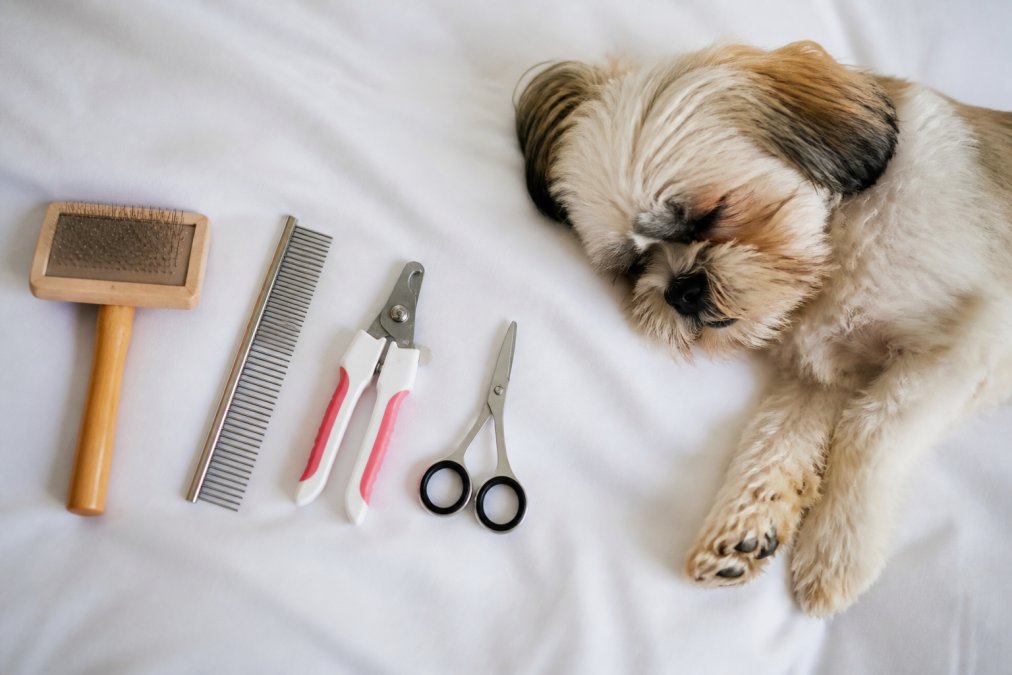
Brushes and Combs for Different Coat Types
Coat type decides which brush you need. Short, smooth coats need a rubber curry brush or soft slicker. Double coats need a metal comb plus undercoat rake. Curly and drop coats need a slicker plus detangling spray, since mats form close to the skin where a brush alone cannot reach.
- Short coats: rubber curry brush or soft slicker, weekly
- Double coats: metal comb plus undercoat rake, two to three times weekly
- Curly coats: slicker brush plus detangling spray, daily during shedding season
- Long silky coats: pin brush plus metal comb, daily
- Hairless or very short coats: soft cloth or curry brush, weekly
A flea comb earns its place in any kit, even for indoor pets. It costs little, doubles as a face comb for short-haired breeds, and catches skin debris you would otherwise miss.
Nail Care: Clippers vs. Grinders
Nail grinders beat guillotine clippers for beginners because a rotary head removes small amounts at a time, so one slip does not cut the quick. Clippers are faster on thick nails and cost less, but demand more confidence and a steady hand.
Many owners keep both: trim the bulk with clippers, then smooth edges with a grinder so the nail is not sharp against floors or skin. Whichever you choose, look for a low-noise motor and ergonomic handle; a loud grinder scares more pets than the grinding itself.
How to Groom a Dog at Home for Beginners
Groom a dog at home in short sessions, front to back, stopping before your dog gets restless. Ten calm minutes beats a forty-minute battle.
- Brush the whole body first to remove loose hair and find mats.
- Comb through the undercoat, section by section, down to the skin.
- Trim nails, taking small passes and avoiding the pink quick.
- Check ears, eyes, and paw pads; trim paw pad hair only if it collects debris.
- Finish with a sanitary trim around the rear using blunt-tip shears.
Total time: 20 to 30 minutes for a cooperative small dog, longer for thick coats. Difficulty: beginner, with practice.
The biggest mistake is starting with the hardest area. Most dogs hate having their feet and face handled, so begin with the back and work toward sensitive zones once your dog relaxes.
Best Dog Grooming Clippers for Thick Hair
Thick and double coats punish weak clippers. The tool must slice through dense undercoat on the first pass, because a blade that stalls and pulls turns a calm dog into a bolting one. Prioritize torque and blade quality over kit size, one well-built clipper outperforms a 12-piece bargain set.
What Actually Matters on a Budget Clipper
- Motor type: A rotary motor spins fast and handles thick, matted, or dirty coats better than a magnetic motor, which is quieter but stalls under load. Most budget clippers under $60 use magnetic motors, so check the spec sheet before buying for a heavy-coated breed.
- Blade material: Stainless steel or ceramic-coated blades hold an edge longer and run cooler. Carbon-steel blades cut well when new but dull faster and heat up sooner.
- Blade size: The standard detachable blade is a #10, which leaves roughly 1/16 inch of coat, the right choice for sanitary trims, paw pads, and mat removal. A #7F or #5F leaves more length for body work. Skip fixed-blade clippers for thick coats; you cannot swap a dull blade, and the whole unit becomes disposable.
- Attachment combs: These snap over the blade to set length without swapping blades, but they snag on mats, so detangle first.
- Runtime and battery: Look for at least 60 minutes of cordless runtime, or a corded option for genuinely dense coats. A spare battery or fast-charge dock prevents mid-trim dead batteries.
- Noise: A loud motor spooks nervous pets. Run the clipper near your dog, switched on, before the first trim so the sound is not a surprise.
Cordless vs. Corded Clippers
Cordless clippers win for home use because you can move around a wriggling pet without dragging a cord.
Matching the Clipper to the Coat
Common Clipper Mistakes That Cost You Money
- Pushing a dull blade: Dull blades pull hair instead of cutting it, which hurts your pet and forces you to replace the blade sooner.
How Often Should You Groom Your Pet?
Grooming frequency is a schedule per coat type, not one generic routine.
Coat-Matched Grooming Schedule
| Coat Type | Brushing | Nail Trim | Bath | Full Trim |
|---|---|---|---|---|
| Short, smooth (Beagle, Boxer) | Weekly with rubber curry | Every 3-4 weeks | Every 6-8 weeks | Rarely needed |
| Double coat (Husky, Shepherd) | 2-3 times weekly; daily during blowout | Every 3-4 weeks | Every 6-8 weeks | Sanitary trims only |
| Curly / doodle | Daily with slicker plus detangling spray | Every 3-4 weeks | Every 4-6 weeks | Every 6-8 weeks |
| Long silky (Yorkie, Shih Tzu) | Daily with pin brush and metal comb | Every 3-4 weeks | Every 2-4 weeks | Every 4-6 weeks |
| Wire (Terrier, Schnauzer) | 2-3 times weekly | Every 3-4 weeks | Every 6-8 weeks | Every 8-12 weeks |
| Hairless / very short | Weekly with soft cloth | Every 3-4 weeks | Weekly wipe-down | Not applicable |
Why the Intervals Change
- Shedding season: Double-coated breeds blow their undercoat twice a year, usually spring and fall.
A Simple Way to Remember It
Safety Tips and Desensitization Techniques for Home Grooming
Pet anxiety around grooming is usually about restraint and noise, not the tools. A non-slip grooming table or rubber mat keeps your pet steady, lowering stress for both of you.
Tool Maintenance and Blade Sharpening
Frequently Asked Questions
What are the best dog grooming tools for at-home use?
A basic kit should include a slicker brush for everyday detangling, an undercoat rake for heavy shedders, a pair of nail clippers or a grinder, and a good pair of grooming shears. For thick coats, add a dematting tool. You do not need to spend a lot to get started. Many budget pet grooming tools work well for routine maintenance between professional visits.
What is the best dog grooming kit for beginners?
Look for a kit that includes a slicker brush, a metal comb, nail clippers, and small scissors. Beginner-friendly kits often include blade guards and attachment combs so you can practice without cutting too short. When learning how to groom a dog at home for beginners, start with just a few tools and add more as you get comfortable handling your pet.
How often should you groom your pet?
Most dogs need brushing two to three times per week to prevent matting, though heavy shedders may need daily brushing during shedding season. Nails should be trimmed every three to four weeks. Bathe your dog every four to six weeks unless they get dirty more often. Cats usually need less frequent grooming, but long-haired cats need daily brushing to avoid mats.
Are budget pet grooming tools as good as expensive ones?
For routine home grooming, budget tools work well if you maintain them properly. The main differences are blade quality and motor power. Inexpensive clippers may struggle with very thick or matted coats, so if your dog has thick hair, spend a little more on clippers with a stronger motor. For brushes and combs, budget options are often just as effective.